
Best Courses to Study in Germany
Table of Contents
- Universities for the Best Courses to Study in Germany
- List of the Best Courses to Study in Germany
- Eligibility and Academic Requirements for Studying in Germany
- Cost of Studying for the Best Courses to Study in Germany
- Cost of Living in Germany for International Students
- Scholarships for the Best Courses to Study in Germany
- Intakes for the Best Courses to Study in Germany
- Admission Process for the Best Courses to Study in Germany
- Student Visa Requirements for the Best Courses to Study in Germany
- Career Opportunities After the Best Courses to Study in Germany
- Final Thoughts from Author
Germany's top-tier education system is globally recognised for excellence in STEM and business, with degrees in Engineering (Mechanical and Automotive), Computer Science (AI and Data Science), and Business Management offering strong career prospects.
Leading public universities such as the Technical University of Munich (TUM), LMU Munich, Heidelberg University, and many others provide high-quality education with low or no tuition fees for most students.
Students should choose a course based on their academic background, career goals, language preference, and budget. The table below provides a quick overview of the best courses to study in Germany, including top universities, tuition fees, study duration, living costs, work rights, and post-study opportunities.
The table below provides a quick overview of what is the best course to study in Germany:
Parameter | Details |
Average Duration | Bachelor’s: 3-4 years; Master’s: 1-2 years |
Average Tuition Fees | Public universities: low or no tuition; private universities: higher fees |
Living Cost | Around €900-€1,500/month (≈ INR 1 L-INR 2 L) |
Blocked Account | €11,904/year (≈ INR 13 L) |
Popular Intakes | Winter and Summer |
Work Rights | 140 full days or 280 half-days/year |
Post-Study Stay | 18-month residence permit to search for skilled employment |
Universities for the Best Courses to Study in Germany
Germany has several globally ranked universities for students wondering what are the best course to study in Germany across engineering, science, business, medicine, humanities, and technology.
TUM, RWTH Aachen and KIT are particularly strong for technical fields, while LMU Munich, Heidelberg, Freie Universität Berlin and Humboldt University provide broader options across sciences, medicine, humanities, social sciences and interdisciplinary research.
The table below compares the top universities:
Universities for the Best Courses to Study in Germany | QS World University Rank 2027 | Tuition and Mandatory Fees (Approx.) |
Technical University of Munich (TUM) | 25 | Non-EU students: Bachelor's €2,000-€3,000/semester (≈ INR 2 L-3 L) |
LMU Munich | 61 | No tuition fee; semester contribution €85 (≈ INR 9,000) |
Heidelberg University | 86 | Non-EU tuition €1,500/semester (≈ INR 2 L), plus semester contribution €161 (≈ INR 18,000) |
Freie Universität Berlin | =98 | No tuition fee; semester contribution €358 (≈ INR 39,000) |
RWTH Aachen University | 104 | No tuition fee; semester contribution €340 (≈ INR 37,000) |
KIT Karlsruhe | 110 | Non-EU tuition €1,500/semester (≈ INR 2 L), plus semester contribution €191 (≈ INR 21,000) |
Humboldt University Berlin | =140 | No tuition fee; semester contribution €356 (≈ INR 39,000) |
List of the Best Courses to Study in Germany
The answer to what are the best course to study in Germany depends on whether you want technical, analytical, managerial or healthcare work.
Engineering and technology remain major strengths, while AI, data, sustainability and healthcare have become increasingly important. Business and finance are also valuable for students targeting European companies, consulting firms and financial institutions.
The table below compares major study fields, typical duration and common career directions:
Course Area | Typical Duration | Common Career Roles |
Engineering | 3-4 years / 1.5-2 years | Mechanical, Electrical, Mechatronics, Civil, Chemical, Aerospace, Environmental |
Computer Science | 3-4 years / 2 years | Software, cloud, cybersecurity and IT |
Data Science | 1.5-2 years | Analytics, machine learning and data engineering |
Artificial Intelligence | 1.5-2 years | AI development, robotics and computer vision |
Business and Management | 1-2 years | Consulting, operations, marketing and strategy |
Automotive Engineering | 1.5-2 years | E-mobility, vehicle systems and manufacturing |
Finance | 1-2 years | Banking, risk, FP&A and fintech |
Healthcare and Life Sciences | 2-6+ years | Clinical care, research and biotechnology |
Renewable Energy | 1.5-2 years | Energy systems, sustainability and climate technology |
Eligibility and Academic Requirements for Studying in Germany
Academic requirements vary by degree level and chosen university. Bachelor’s applicants need a recognised higher-education entrance qualification and master’s programs, students need a relevant bachelor’s degree from a recognised institution.
For bachelor’s programs, Indian students may need Studienkolleg, JEE Advanced, or one year of recognised university study depending on course and background.
The table below summarises common eligibility expectations:
Requirement | Bachelor’s Applicant | Master’s Applicant |
Academic Qualification | Class 12 + recognised pathway | Relevant bachelor’s degree |
Subject Background | Course-relevant school subjects | Required bachelor’s modules and credits |
Language Proof | English or German, depending on course | English or German, depending on course |
APS | Generally required for Indian applicants | Generally required for Indian applicants |
Entrance Route | Direct entry or preparatory pathway | Direct program application |
Supporting Documents | Transcripts, passport and certificates | Transcripts, CV, motivation letter and references where required |
English and German Language Requirements
English-taught MBA courses in Germany usually require proof of English language proficiency through IELTS Academic, TOEFL iBT, PTE Academic, or Cambridge English qualifications.
German-taught programs usually require recognised certificates such as TestDaF, DSH, telc or Goethe qualifications at the level specified by the institution.
The minimum score varies by university, but most master's and MBA programs have specific English language requirements that applicants must meet.
The table below shows common English language requirements:
Test | Common Score |
IELTS Academic | Around 6.0-7.0 |
TOEFL iBT | Around 80-100 |
PTE Academic | 55-70 |
Cambridge English | C1 Advanced or C2 Proficiency |
TestDaF | Often TDN 4 for German-taught degrees |
DSH | Commonly DSH-2 |
Goethe/telc | Level depends on the course |
Medium of Instruction | Accepted only where officially permitted |
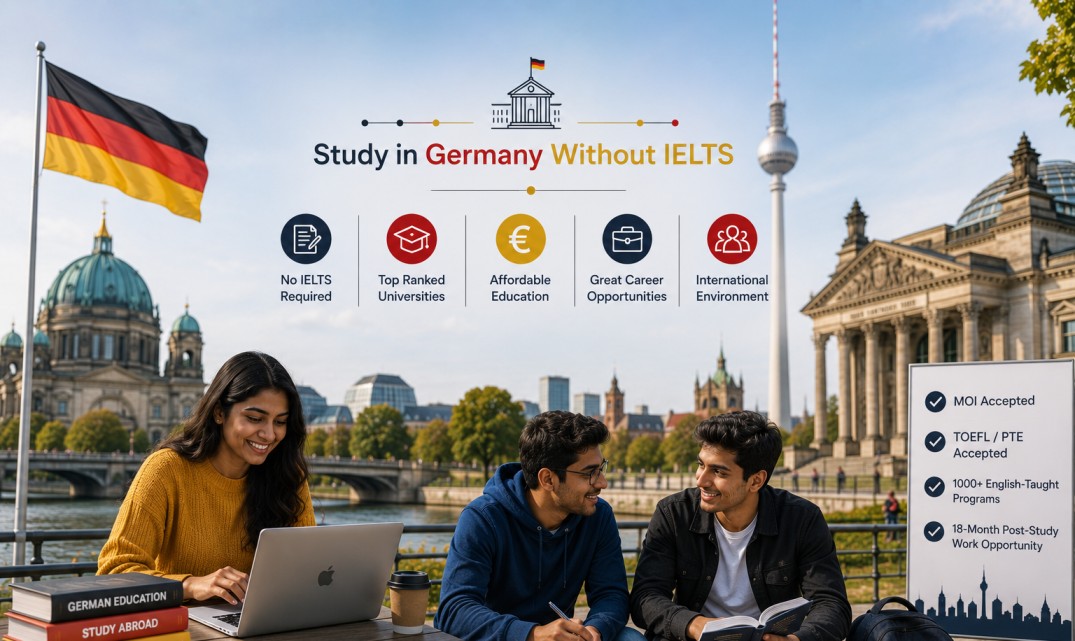
Also Read: Study in Germany Without IELTS
Cost of Studying for the Best Courses to Study in Germany
The cost of studying in germany is lower than in many English-speaking countries and depends on the institution and course category.
Public universities may waive general tuition, but semester contributions, student-service charges and course-specific fees remain payable. Some universities, private institutions, and specialised programs charge tuition.
The table below gives a practical cost estimate:
Expense | Euro Amount (Approx.) | INR Equivalent (Approx.) |
Public University Semester Fee | Usually no general tuition ; €150-€400/semester | ≈ INR 16,000-44,000 |
Baden-Württemberg Non-EU Tuition | €1,500/semester | ≈ INR 2 L |
TUM Non-EU Tuition | Program-specific; commonly €2,000-€6,000/semester | ≈ INR 2 L-7 L |
Private University Tuition | Full annual or semester tuition; Around €5,000-€25,000+/year | ≈ INR 5 L-27 L+ |
MBA and Executive Programs | May reach €20,000-€50,000+ | ≈ INR 22 L-54 L+ |
Cost of Living in Germany for International Students
Students in Germany usually need to budget for accommodation, food, transport, health insurance, and other daily expenses, depending on the city and lifestyle.
Living costs are generally higher in cities such as Munich, Frankfurt, Hamburg, and parts of Berlin, while many smaller university cities offer a more affordable cost of living.
The table below gives a simple monthly budget:
Expense | Monthly Cost | INR Equivalent |
Rent and Utilities | €400-€900 | ≈ INR 44,000-98,000 |
Food and Groceries | €200-€350 | ≈ INR 22,000-38,000 |
Health Insurance | €120-€150 | ≈ INR 13,000-16,000 |
Transport | €49-€100 | ≈ INR 5,000-11,000 |
Personal Expenses | €100-€200 | ≈ INR 11,000-22,000 |
Scholarships for the Best Courses to Study in Germany
German Scholarships can help students cover living costs, insurance, travel, and sometimes tuition.
Eligibility differs by nationality, degree level, field, professional experience and social engagement.
Since many public universities are already low-cost, scholarships in Germany often focus on monthly support rather than full tuition waivers.
The table below lists major scholarship options:
Scholarship | Benefit | INR Equivalent |
DAAD Master’s Scholarship | €992/month | ≈ INR 1 L/month |
Deutschlandstipendium | €300/month | ≈ INR 33,000/month |
Erasmus+ | Varies | Depends on program |
Heinrich Böll Foundation | Varies | Depends on level |
University Scholarships | Varies | Depends on university |
Also Read: Scholarships for Indian Students
Intakes for the Best Courses to Study in Germany
Intakes to Study in Germany are mainly offers Winter and Summer semesters. Winter is the principal intake and generally provides a wider course selection. Summer offers fewer programs, but it can still be suitable for selected engineering, science, business and postgraduate courses.
The table below explains the common intake timeline:
Intake | Classes Begin | Common Deadline |
Winter Intake | September / October | March-July |
Summer Intake | March / April | October-January |
Note: Apply early enough to complete APS, language tests, certified documents, university evaluation, financial planning and the visa process..
Admission Process for the Best Courses to Study in Germany
Applications differ by university and program. Most students apply either through the university portal or through uni-assist, depending on the institution.
Students should first confirm degree recognition, subject eligibility, language requirements and application deadlines.
The table below outlines the main application stages:
Step | What to Do |
1 | Choose a subject, degree level and preferred language |
2 | Shortlist recognised universities and compare curricula |
3 | Check qualification and prerequisite-module requirements |
4 | Complete APS verification where required |
5 | Take the required English or German test |
6 | Prepare transcripts, CV, motivation letter and supporting documents |
7 | Apply directly, through uni-assist or via Hochschulstart |
8 | Respond to document or interview requests |
9 | Accept the offer and complete enrolment conditions |
10 | Arrange finances, insurance, accommodation and visa documents |
Note: Applicants should keep certified translations and digital copies ready. Some universities also require a VPD from uni-assist before accepting a direct application.
Student Visa Requirements for the Best Courses to Study in Germany
To study the best courses to study in germany, non-EU students usually need a German student visa or residence permit.
Students need an admission letter, proof of funds, health insurance, language proof, academic documents, and a valid passport.
The table below lists common requirements:
Visa Requirement | General Requirement |
University Admission | Valid admission or accepted preparatory-course offer |
Passport | Valid travel document |
Financial Proof | Usually €11,904/year (≈ INR 13 L) |
Health Insurance | Valid coverage for entry and study |
Academic Documents | Certified school or degree records |
APS Certificate | Generally required for Indian applicants |
Language Proof | Based on the course and visa file |
Motivation Letter and CV | Commonly included |
Biometric Photographs | As specified by the mission |
Visa Fee | €75 (≈ INR 8,000) |
Note: After graduation, international students can apply for an 18-month residence permit to search for skilled employment in Germany.
Career Opportunities After the Best Courses to Study in Germany
Graduates can pursue careers in Germany’s industrial, digital, healthcare, financial and sustainability sectors.
Job outcomes depend on the degree, prior experience, German ability, location and technical skills.
The table below compares major career paths:
Course Area | Job Roles | Salary Range |
Engineering | Mechanical Engineer, R&D Engineer | €52,000-€80,000 (≈ INR 57 L-INR 87 L) |
Computer Science | Software Engineer, Cloud Engineer | €56,000-€79,000 (≈ INR 61 L-INR 86 L) |
Data Science | Data Scientist, BI Analyst | €57,000-€80,000 (≈ INR 62 L-INR 87 L) |
AI | AI Engineer, ML Engineer | €55,000-€85,000 (≈ INR 60 L-INR 93 L) |
Business | Consultant, Business Analyst | €45,000-€75,000 (≈ INR 49 L-INR 82 L) |
Finance | Analyst, Risk Associate | €45,000-€90,000 (≈ INR 49 L-INR 98 L) |
Life Sciences | Research Associate, Biotech Analyst | €48,000-€75,000 (≈ INR 52 L-INR 82 L) |
Note: Germany allows eligible third-country graduates to apply for a residence permit of up to 18 months to search for qualified employment after completing a German degree.
Final Thoughts from Author
The best courses to study in Germany are those that match your previous education, ability and long-term plans.
Engineering, Computer Science, Data Science, AI, Finance, Healthcare and Renewable Energy can all lead to strong outcomes ,but do not choose a course only because it sounds popular.
Compare the curriculum, tuition, city, internship access and realistic job requirements first.
Students asking what is the best course to study in Germany should begin with their academic strengths and then shortlist suitable universities.
Still have Doubts about Best Courses to Study in Germany? Book a free 1:1 counselling session With our study abroad experts for personalised guidance.