Study in Germany Without IELTS
Table of Contents
- Top German Universities That Accept Students Without IELTS
- Popular Courses to Study in Germany Without IELTS
- How to Study in Germany Without IELTS
- Eligibility Requirements to Study in Germany Without IELTS
- Documents Required to Study in Germany Without IELTS
- Cost of Studying in Germany Without IELTS
- Cost of Living in Germany for International Students
- Scholarships to Study in Germany Without IELTS
- Benefits of Studying in Germany Without IELTS
- Final Thoughts from Author
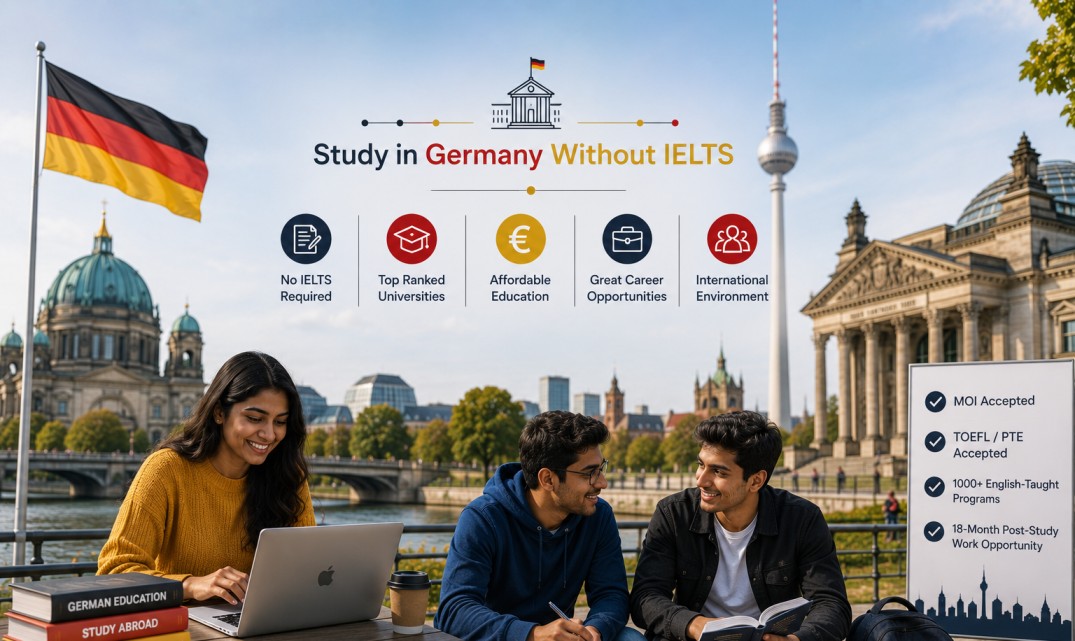
Students can Study in Germany Without IELTS if their chosen university accepts another recognised proof of English proficiency, such as a Medium of Instruction (MOI) certificate, TOEFL iBT, PTE Academic, Cambridge English qualifications, or other approved alternatives.
Many leading universities, including the Technical University of Munich (TUM), LMU Munich, Heidelberg University, Freie Universität Berlin, RWTH Aachen University, and KIT Karlsruhe, accept alternative English language proofs for selected programs.
Germany offers more than 1,800 English-taught programs, affordable public universities, globally recognised degrees, and excellent career opportunities for students. T
The table below gives a quick overview of what students should know before applying.
Parameter | Details |
IELTS Alternative | MOI, TOEFL, PTE, Cambridge, selected interviews |
Top Ranking Source | QS World University Rankings 2027 |
Blocked Account | €11,904/year (≈ INR 13 L) |
Monthly Proof of Funds | €992/month (≈ INR 1.08 L) |
Public University Fees | €100-€400/semester (≈ INR 11K-44K) |
Private University Fees | €5,000-€20,000/year (≈ INR 5 L-22 L) |
APS for Indian Students | Mandatory for most Indian applicants |
Work Rights | Up to 140 full days or 280 half days/year |
Popular Fields | Engineering, CS, Business, Data Science, Management |
Top German Universities That Accept Students Without IELTS
Many German universities allow students to apply without IELTS, but they still ask for valid English proof.
Several public and private universities follow this approach. For example, the Technical University of Munich (TUM) accepts proof of previous English-medium education for selected programs, where permitted under the program's admission requirements.
The table below highlights some German universities that accept alternatives to IELTS for eligible programs:
Universities to Study in Germany Without IELTS | QS World University Rankings 2027 | IELTS Alternative |
Technical University of Munich | 25 | MOI/English-taught degree, TOEFL, PTE, Cambridge |
LMU Munich | 61 | Program-specific English proof |
Heidelberg University | 86 | TOEFL, Cambridge, program-level proof |
Freie Universität Berlin | =98 | TOEFL, Cambridge, school/degree-level English proof |
RWTH Aachen University | 104 | TOEFL, PTE, Cambridge, UNIcert |
KIT Karlsruhe | 110 | Program-specific English proof |
University of Hamburg | 721-730 | Course-specific English proof |
Popular Courses to Study in Germany Without IELTS
Students can study without IELTS across many English-taught programs if the university accepts an alternative proof.
Popular choices include engineering, computer science, data science, finance, management, renewable energy, public health, and international business.
The table below lists common course options:
Course Area | Popular Programs |
Engineering | Mechanical, Automotive, Electrical, Civil |
Computer Science | AI, Data Science, Cybersecurity, Software Engineering |
Business | MBA, Finance, International Management |
Science | Biotechnology, Physics, Environmental Science |
Healthcare | Public Health, Health Management |
Design & Media | Digital Media, UX, Communication |
How to Study in Germany Without IELTS
Students can study without IELTS by choosing English-taught programs that accept MOI or other English tests.
The safest approach is to first shortlist programs, then check each university’s official language requirement page, and only then prepare your application documents.
Follow these steps:
1. Shortlist English-taught programs: Shortlist Bachelor's or Master's programs through the DAAD database or official university websites.
2. Check IELTS waiver or alternative proof: Check the language requirements for selected course and confirm whether the university accepts an IELTS waiver, MOI certificate, TOEFL, PTE Academic, Cambridge English, or another approved alternative.
3. Arrange English proficiency proof: Arrange accepted English proficiency proof, such as an MOI certificate issued by your previous institution or a valid TOEFL, PTE, or Cambridge English score, if required.
4. Apply for APS Certificate: If students are applying from India, apply for APS Certificate, as it is mandatory for most German university applications and student visa processing.
5. Submit applications through university portal or uni-assist: Submit the application through the university's official admission portal or uni-assist.
6. Arrange blocked account and visa documents: After receiving the admission letter, arrange German blocked account with the required €11,904 (≈ INR 13 L), and prepare the remaining visa documents.
7. Apply for German student visa: Apply for German student visa appointment, submit all required documents, complete the biometric process.
Eligibility Requirements to Study in Germany Without IELTS
To Study in Germany Without IELTS, students must meet the academic eligibility requirements and submit an accepted alternative to IELTS for English language proficiency, wherever applicable.
Although IELTS may be waived by some universities, admission is not automatic.
Applicants must meet the university's academic criteria, provide valid supporting documents, and submit an English language proof accepted for the chosen program.
The table below explains the basic eligibility criteria.
Level | Academic Requirement | English Requirement |
Bachelor’s | Class 12 + German equivalency rules | MOI or accepted test |
Master’s | Relevant bachelor’s degree | MOI, TOEFL, PTE, Cambridge |
MBA | Bachelor’s + work experience in some cases | Test/MOI/interview, depending on school |
PhD | Master’s degree + research proposal | Supervisor/program requirement |
Academic Requirements to Study in Germany Without IELTS
Students must meet the academic and English language requirements set by the university.
Instead of IELTS, many universities accept other recognised forms of English language proof.
The common eligibility requirements are:
Recognised Class 12 qualification or equivalent for bachelor's programs.
Recognised bachelor's degree in a relevant field for master's programs.
CEFR level (usually B2 or C1) accepted for certain programs.
Online interview or internal English assessment conducted by a few universities.
APS Certificate required for most Indian applicants before the visa process.
English Language Tests Accepted to Study in Germany Without IELTS
To study without IELTS, students must usually prove English through another accepted route.
The most common alternatives are MOI, TOEFL iBT, PTE Academic, Cambridge English, or course-level proof.
Duolingo is accepted by selected institutions, but students must confirm this directly on the university’s official course page.
The table below shows the most common IELTS alternatives.
Alternative | Typical Use | Best For |
MOI Certificate | Confirms previous education was in English | Indian graduates from English-medium colleges |
TOEFL iBT | Widely accepted by public universities | Master’s and technical programs |
PTE Academic | Accepted by many universities | Students wanting faster results |
Cambridge C1/C2 | Strong academic English proof | Competitive English-taught programs |
Duolingo | Accepted by selected universities | Private/applied science universities |
Documents Required to Study in Germany Without IELTS
Students planning to Study in Germany Without IELTS must prepare documents for both admission and visa.
The most important point is that your admission letter should clearly show that the university has accepted your English proof or does not require IELTS for that program.
Germany’s official study portal states that most students need €11,904/year (≈ INR 13 L) as proof of financial resources.
The table below lists the key documents:
Document | Purpose |
MOI Certificate | IELTS alternative |
Academic Transcripts | Admission review |
Degree/Provisional Certificate | Academic eligibility |
APS Certificate | Mandatory for most Indian applicants |
SOP/Motivation Letter | Course intent |
LORs | Academic/professional support |
CV/Resume | Profile summary |
Passport | Application and visa |
Blocked Account Proof | Financial proof |
Health Insurance | Visa and enrolment |
Cost of Studying in Germany Without IELTS
The cost to Study in Germany Without IELTS is usually lower than in many other European countries.
Public universities usually charge only a semester contribution, while private universities may have higher annual tuition fees.
While planning the cost of studying in Germany, students should also include APS, visa fees, health insurance, blocked account funds, living expenses, travel, and other one-time charges.
Since many universities accept alternatives such as a Medium of Instruction (MOI) certificate, IELTS may not always be required, helping some students save on English test costs.
The table below shows the estimated study cost:
Cost Type | Euro Amount | INR Equivalent |
Public University Semester Fee | €100-€400 | ≈ INR 11K-44K |
Baden-Württemberg Tuition | €1,500/semester | ≈ INR 1.6 L |
Private University Tuition | €5,000-€20,000/year | ≈ INR 5 L-22 L |
Blocked Account | €11,904/year | ≈ INR 13 L |
Monthly Living Proof | €992/month | ≈ INR 1.08 L |
General Visa Fee | €75 | ≈ INR 8K |
IELTS Saving | €200-€250 | ≈ INR 22K-27K |
Cost of Living in Germany for International Students
Germany requires students to show sufficient financial resources for living expenses before arriving in the country.
The monthly cost of living depends on the city, accommodation, and personal lifestyle. Cities such as Munich and Frankfurt are generally more expensive, while Berlin and many smaller university towns can be more affordable.
Students should also budget for accommodation, food, transport, health insurance, and other daily expenses.
The table below gives a practical monthly cost range:
Expense | Monthly Cost | INR Equivalent |
Rent | €350-€800 | ≈ INR 38K-87K |
Food | €200-€300 | ≈ INR 22K-33K |
Health Insurance | €120-€150 | ≈ INR 13K-16K |
Transport | €40-€60 | ≈ INR 4K-7K |
Internet & Phone | €30-€50 | ≈ INR 3K-5K |
Personal Expenses | €100-€200 | ≈ INR 11K-22K |
Source: Numbeo
Read About: Scholarships for Indian Students in Germany
Scholarships to Study in Germany Without IELTS
Scholarships can help reduce the total cost to Study in Germany Without IELTS.
Most scholarship providers focus on academic merit, leadership, social commitment, and financial need rather than only English test scores.
IELTS is not always mandatory, but students must meet the language requirements accepted by the university or scholarship provider.
The table below lists useful scholarship options:
Scholarship | Benefit | INR Equivalent |
DAAD Scholarships | €992/month for students | ≈ INR 1.08 L/month |
DAAD PhD Funding | €1,300/month | ≈ INR 1.42 L/month |
Deutschlandstipendium | €300/month | ≈ INR 33K/month |
Heinrich Böll Foundation | Monthly support varies by level | Check official criteria |
Friedrich Ebert Foundation | Merit-based support | Check official criteria |
Benefits of Studying in Germany Without IELTS
Choosing to Study in Germany Without IELTS can help students save time, test fees, and the effort of preparing for an English language exam.
It can be a good option for students who have completed their previous education in English and can provide a Medium of Instruction (MOI) certificate or meet the university's English language waiver policy.
However, not all universities offer an IELTS waiver, so students should always check the official admission requirements before applying.
Key benefits include:
Saves €200-€250 (≈ INR 22K-27K) in IELTS-related costs.
Helps students apply faster if MOI is ready.
Opens access to low-cost public universities.
Allows flexibility through TOEFL, PTE, Cambridge, or MOI.
Keeps scholarship options open.
Supports career planning in Europe after graduation.
Also Read: Jobs in Germany after MBA
Final Thoughts from Author
Studying in Germany without IELTS can be a great option if your previous education was in English or if your chosen university accepts alternatives such as a Medium of Instruction (MOI) certificate, TOEFL, PTE, or Cambridge English qualifications.
However, every university has its own admission policy, so always check the official course requirements before applying.
Students should shortlist a few universities, compare their eligibility criteria, tuition fees, scholarships, and career opportunities, and complete important steps like document preparation well before the application deadline.
Want to know more about studying in Germany without IELTS? Book a free 1:1 counselling session with our study abroad experts for personalised guidance.