PHD in Germany
Table of Contents
- Top Universities and Research Institutes for PHD in Germany
- Popular Research Fields for PHD in Germany
- Types of PHD Programs in Germany
- Admission Requirements for PHD in Germany
- Intakes for PHD in Germany
- PHD Positions in Germany
- Application Process for PHD in Germany
- Cost of Pursuing a PHD in Germany
- PhD Stipend in Germany
- PHD in Germany with Scholarship
- Germany Student Visa Requirements for PhD Students
- Career Opportunities After PHD in Germany
- Author's Final Thoughts
Germany has one of Europe's strongest research ecosystems, bringing together internationally recognized universities, specialized research organizations and large-scale research infrastructure. Your PhD can take place not only inside a university department but also within institutions such as the Max Planck Society, Helmholtz Association and Fraunhofer research network.
More than 212,000 researchers were pursuing doctorates in Germany in 2024, of which 25% being foreign citizenship, showing how international the country's doctoral environment has become.
Germany offers two major routes to a doctorate: the traditional individual PhD, where you develop your research under a professor, and structured doctoral programmes with organized training, seminars and potentially multiple supervisors.
You do not normally pay tuition fees at public universities for a PhD, although doctoral candidates pay a semester contribution, which Research in Germany places broadly at €70–€330 per semester (Approx. ₹7,000–₹33,000) depending on the institution and included services.
Funding is one of the biggest attractions for international PhD students. Doctoral candidates may receive a paid research position or scholarship, rather than funding the entire doctorate from personal savings. DAAD doctoral research grants, for example, currently offer €861–€1,200 per month (Approx. ₹1.02–₹1.42 lakh) depending on qualifications, along with additional allowances.
PhD in Germany is not limited to traditional university departments. Research opportunities exist across organizations such as the Max Planck Society, Helmholtz Association and Fraunhofer Institutes, giving students exposure to fundamental research as well as applied and industry-oriented projects.
English can be enough for many doctoral opportunities. Many structured programmes and research positions, particularly in STEM and internationally oriented research groups, operate in English, although German may be necessary for certain disciplines, research environments or everyday professional interactions.
For Indian students, the route can be particularly attractive when the PhD is funded. Instead of looking only for a university offering admission, you can also search for PhD positions in Germany, research-assistant vacancies and doctoral projects advertised by research institutes.
The doctorate can also be a route into Germany's wider research and industrial ecosystem. Germany reports roughly 5,800 international graduates completing doctorates each year, while its research system provides pathways towards postdoctoral research, university careers and industry R&D.
In this guide, we'll cover the best universities and research institutes, popular research areas, PhD types, eligibility, application process, costs, PhD stipend in Germany, scholarships, visa requirements and career opportunities after completing your doctorate.
Top Universities and Research Institutes for PHD in Germany
Study in Germany offers broad doctoral ecosystem that includes research-intensive universities as well as specialized research organizations. Research-intensive universities provide doctoral supervision and academic infrastructure, while organizations such as the Max Planck Society, Helmholtz Association and Fraunhofer Society offer research environments closely connected with major scientific and industrial projects.
University | Why Consider It |
Technical University of Munich (TUM) | Relevant for doctoral research in engineering, computer science, natural sciences, medicine, management and related fields |
LMU Munich | Broad research portfolio and strong academic environment |
Heidelberg University | Research-intensive university with strong interdisciplinary work in mechanical engineering, electrical engineering, computer science, materials, automotive technology and industrial research |
RWTH Aachen University | Best for industrial and engineering research |
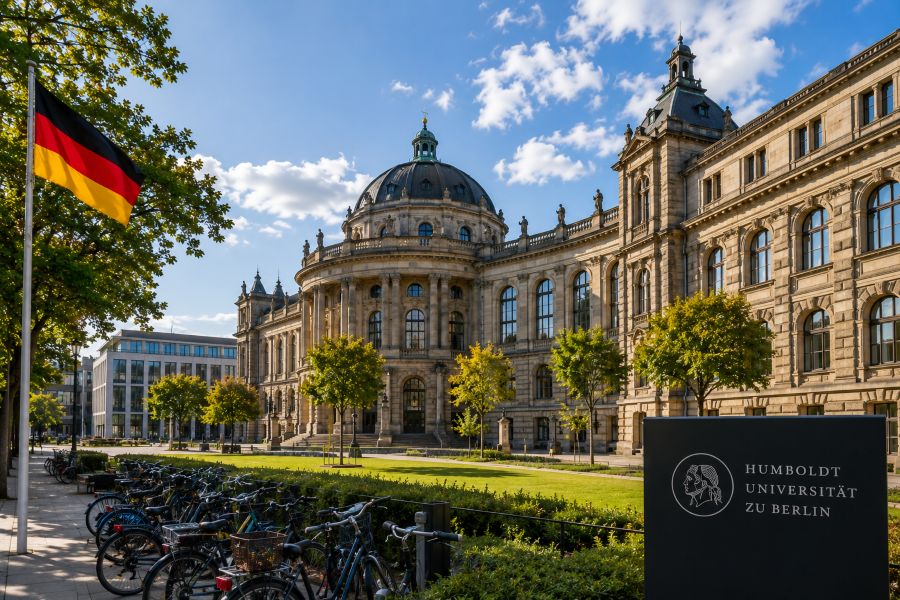
Humboldt University of Berlin | Doctoral research across humanities, social sciences, natural sciences and related disciplines in major academic city, Berlin |
Max Planck Institutes | Specialized fundamental research and advanced facilities, covering fields such as physics, chemistry, biology, neuroscience, computer science, economics and social sciences |
Helmholtz Association | Large-scale interdisciplinary research addressing areas such as health, energy, climate, environment, materials and information. |
Fraunhofer Institutes | Strong focus on applied and industry-oriented research on areas such as manufacturing, information technology, energy, materials, mobility and communications. |
For PhD in Germany for Indian students, the right choice should depend on research fit, supervisor expertise, funding and the availability of a suitable PhD position in Germany should be the main factors when shortlisting institutions.
Popular Research Fields for PHD in Germany
German research is strong across STEM, business and the humanities. The best research field for should not depend on popularity and more on whether Germany has active research groups working on your proposed topic,appropriate supervisors and funding. Before applying, compare research centers, recent publications, laboratories, funding projects and potential supervisors in your exact area.
Research Field | Common PhD Specializations |
Engineering & Technology | Mechanical, Electrical, Automotive, Robotics, Materials, Manufacturing |
Computer Science & AI | AI, Machine Learning, Data Science, Cybersecurity, Robotics |
Life Sciences & Biotechnology | Molecular Biology, Genetics, Biotechnology, Neuroscience, Biomedical Research |
Physics & Mathematics | Quantum Science, Particle Physics, Astrophysics, Applied Mathematics |
Business & Economics | Finance, Economics, Management, Marketing, Entrepreneurship |
Social Sciences & Humanities | Sociology, Political Science, History, Philosophy, Linguistics |
Types of PHD Programs in Germany
Germany offers several routes to a doctorate. The individual doctorate provides greater freedom to define and conduct a project, while structured programmes offer a more organized academic environment with multiple supervisors, seminars and milestones. Research institutes and companies can also play a role in doctoral training.
PhD Route | Typical Structure | Best Suited For |
Individual Doctorate | Independent research | Students with a clearly defined research topic |
Structured Doctoral Programme | Research + seminars/training | Students who prefer a structured academic environment |
Research Institute Route | Funded research project | Students interested in specialized or applied research |
Research in Germany notes that structured doctoral programmes take around three to five years, with many programmes designed around a defined curriculum and research project.
Feature | Individual Doctorate | Structured Programme |
Supervision | Usually one main professor | Team of supervisors |
Research | Highly independent | Programme-based |
Coursework | Limited/varies | More structured |
Duration | Often 5–6 years | 3–5 years |
Funding | Position or scholarship | Often funded position/grant |
Admission Requirements for PHD in Germany
Admission requirements vary by university, doctoral school and discipline, so there is no single nationwide checklist that guarantees admission. PhD application is centred around your research potential. For an individual doctorate, securing a suitable supervisor is one of the most important steps before formal admission.
Documents Required for Admission:
Requirement | What Universities Usually Look For |
Academic Qualification | Relevant Master's degree or equivalent |
Academic Performance | Strong grades, particularly in the relevant subject |
Research Proposal | Clear research question, methodology and expected contribution |
Language | English or German depending on programme |
Research Experience | Thesis, publications, projects or laboratory experience where relevant |
Supervisor | Required for most individual doctorate routes |
Recommendations | Academic references from professors/research supervisors |
Additional documents may be required depending on the university and country of previous education.
Finding and Securing a PhD Supervisor
For an individual doctorate, finding the right supervisor is the most important step before formal application. Start by identifying professors and research groups working in the same area of topic.
Read their recent publications, research projects and current group work before contacting them.
A generic email sent to dozens of professors is much less effective than a short, tailored message explaining your research idea and why their group is relevant.
Intakes for PHD in Germany
Doctoral studies in Germany do not follow one universal national intake calendar. This is especially important when searching for PhD positions in Germany. A doctoral vacancy may become available whenever research funding is approved, a project begins or a position opens within a research group.
General public university enrollment deadlines are July 15 for the winter semester and January 15 for the summer semester, but specific graduate schools set their own independent cycles.
This means that a suitable PhD position can appear at different points during the year.
H3: Best Time to Apply for a PhD in Germany
There is no universally "best" month to apply. A better strategy is to start searching 6–12 months before your intended start date and monitor university departments, research institutes and doctoral vacancy databases regularly.
For scholarship applications, however, deadlines can be fixed. DAAD doctoral funding deadlines are updated annually.
Need Help Finding a PhD in Germany? Get expert guidance on university shortlisting, research proposals, supervisor outreach, scholarships, applications, visas, and career planning. Visit Study Overseas Germany to get personalized guidance for your PhD journey. |
PHD Positions in Germany
PhD positions in Germany can be advertised as research-associate, doctoral researcher or project-based vacancies. Research in Germany notes that doctoral students commonly work as academic assistants or research associates, while the German government also highlights opportunities to combine a research-assistant job with doctoral research.
Position Type | Funding Structure | Typical Work |
University PhD Position | Employment contract | Research, teaching and academic work |
Research Assistant | Paid university/research role | Research + supporting project activities |
Funded Doctoral Vacancy | Project-funded employment | Research within a defined project |
Scholarship PhD | Monthly scholarship | Primarily doctoral research |
Application Process for PHD in Germany
Applying for a PhD is more research-driven than applying for a taught degree. You need to establish a convincing match between your academic background, research question, supervisor and funding opportunity.
Step 1: Identifying Research Opportunities
Begin with:
University research groups
Structured doctoral programmes
PhDGermany
Max Planck Institutes
Helmholtz centres
Fraunhofer Institutes
Research project vacancies
DAAD scholarship database
Research in Germany recommends databases and research maps for identifying universities and institutes active in specific research areas.
Step 2: Contacting Potential Supervisors
For an individual doctorate, contact professors whose research directly overlaps with your proposed project.
Your initial email should generally include:
Brief academic introduction
Your Master's field
Proposed research area
Why their research group fits
Short research proposal
CV
Relevant publications, if available
Avoid sending long, generic emails. The goal is to establish a research fit, not to write your entire application in the first message.
Step 3: Preparing a Competitive Research Proposal
Your proposal should demonstrate that you understand the research problem and have a realistic plan for addressing it.
A strong proposal should answer three basic questions:
-What is the problem?
Explain the research gap clearly.
-How will you investigate it?
Present an appropriate methodology.
-Why does it matter?
Explain the academic or practical contribution.
Step 4: Application and Interview Process
The exact process varies. A typical sequence can include supervisor approval, formal university admission, funding confirmation and enrolment.
Structured programmes may conduct competitive selection rounds involving document screening and interviews. Funded research positions may follow a job-application process and include an academic interview with the research group.
Cost of Pursuing a PHD in Germany
PhD in Germany is funded with scholarship or research position that does not require to pay conventional tuition. Public universities do not charge doctoral tuition, but students still have semester contributions and living expenses.
Tuition Fees and Semester Contributions
Public universities do not charge tuition for doctoral studies. DAAD states that doctoral studies at German public universities are tuition-free for at least the first six semesters. Students only pay a semester contribution, which varies by institution and services included.
For research in Germany, semester contributions range from approximately €70–€330 (Approx. ₹7,000–₹33,000) per semester.
Living Expenses for PhD Students
Living costs are higher in cities such as Munich and Frankfurt than in smaller university towns. A doctoral candidate should budget for accommodation, food, transportation, insurance and personal expenses even when tuition is not charged.
Expense | Approximate Monthly Cost |
Accommodation | €400–€900 (Approx. ₹40,000–₹90,000) |
Food & Groceries | €200–€350 (Approx. ₹20,000–₹35,000) |
Transport | €50–€100 (Approx. ₹5,000–₹10,000) |
Health/Personal Expenses | €150–€300 (Approx. ₹15,000–₹30,000) |
Source: Numbeo
Actual spending depends heavily on location, housing arrangement and lifestyle.
PhD Stipend in Germany
PhD stipend in Germany depends on the funding organisation, programme, discipline and candidate's circumstances. A paid research position is technically a salary rather than a stipend, while scholarship recipients receive a fixed monthly amount according to the funding organization's rules.
Funding Type | How It Works |
Research Employment | Salary under an employment contract |
University Funding | Salary or project-based doctoral position |
DAAD Scholarship | Monthly scholarship plus applicable allowances |
Foundation Scholarship | Funding according to individual foundation rules |
Important: Funding varies by source.
PHD in Germany with Scholarship
Students looking for PhD in Germany with scholarship can explore government funding, foundations, university schemes and research organizations. In addition to scholarships, many doctoral candidates are funded through employment contracts attached to research projects.
Scholarship | Suitable For | Key Point |
DAAD | International doctoral researchers | Multiple doctoral funding programmes |
Erasmus+ | Doctoral mobility/research periods | Depends on institutional arrangement |
Max Planck | Research-focused doctoral candidates | Funding often connected to research projects |
University Scholarships | Candidates enrolled/admitted at specific universities | Availability varies |
Research Foundation/Project Funding | Specific research topics | Often linked to a funded project |
Important: When a university advertises a "fully funded PhD", check exactly what the funding covers. A funded research position may provide a salary, while a scholarship may provide a monthly stipend without creating a conventional employment relationship.
Before accepting an offer, compare the monthly funding, contract duration, insurance, research expenses, conference funding and working obligations.
Germany Student Visa Requirements for PhD Students
International doctoral candidates need appropriate residence status based on how their doctorate is structured and funded. Germany allows doctoral candidates to use a study-related residence route or, where the requirements are met, a research residence route. The appropriate option depends on the actual arrangement with the university or research institution.
PhD Visa Eligibility Requirements
A doctoral candidate needs a formal admission or an appropriate research/employment arrangement in Germany.
If the doctorate is conducted as part of a full-time study programme, a study residence permit is required. If the doctoral thesis is carried out as part of a work contract with a research institution, a research residence permit can apply.
Career Opportunities After PHD in Germany
Germany offers career opportunities for PhD graduates both inside and outside academia. The country has a brilliant research ecosystem involving universities, non-university institutes and research-intensive companies. International researchers can move into postdoctoral research, university positions, research institutes, industrial R&D, consulting, technology companies and specialist roles.
Career Path | Potential Roles |
Academia | Postdoctoral Researcher, Lecturer, Professor |
Research Institutes | Research Scientist, Research Group Member |
Industry R&D | R&D Scientist, Research Engineer |
Technology | AI Researcher, Data Scientist, ML Specialist |
Life Sciences | Biotech Scientist, Biomedical Researcher |
Consulting | Research Consultant, Technology Consultant |
Management | R&D Manager, Innovation Manager |
Author's Final Thoughts
PhD in Germany makes most sense for students genuinely interested in research rather than simply looking for another international qualification. Germany's biggest advantage is a strong research ecosystem and low doctoral tuition costs with multiple funding routes. For Indian applicants, the most important decision is whether to pursue an individual doctorate, structured programme or research-institute position. A strong supervisor or research-group match matter more than university ranking alone. If funding is a priority, candidates should actively target paid doctoral positions and scholarships instead of waiting until after admission to solve the financial question. Germany can be an excellent doctoral destination, but the strongest applications are built around a clear research question, relevant academic preparation, supervisor fit and realistic funding plan.
Frequently Asked Questions
At public universities, doctoral studies generally do not have tuition fees, although students pay a semester contribution. DAAD states that doctoral studies at public universities are tuition-free for at least the first six semesters. Students still need to cover living expenses unless their PhD is funded through a scholarship or employment contract.
Yes. Germany accepts international doctoral candidates across a wide range of disciplines. PhD in Germany for Indian students generally involves having a relevant recognised postgraduate qualification, finding a suitable doctoral project and meeting the admission requirements of the university or research institution. Indian applicants should also verify recognition of their academic qualifications and visa requirements.
A relevant Master's degree or equivalent is normally required for doctoral admission. Some exceptional pathways or specific programmes can have different rules. For example, the DAAD Doctoral Programmes in Germany scholarship normally requires a completed Master's degree or Diplom, with exceptional consideration for Bachelor's graduates. The university's own doctoral regulations remain decisive.
The duration varies according to the research field and doctoral structure. Structured programmes commonly take around three to five years, while individual doctorates can take longer; Research in Germany notes that individual doctorates often take around five to six years. Your funding contract, research complexity and dissertation progress can all affect the actual completion time.
IELTS is not universally required. The requirement depends on the university, doctoral programme and language of research. Many international and STEM research environments operate in English, while some projects require German. If your previous degree was taught in English, a university may accept alternative evidence of proficiency, but this must be confirmed with the specific institution.
You can search university career pages, doctoral programme websites, research institutes and specialist databases such as PhDGermany. Research in Germany also recommends using research databases and university research maps to identify groups working in your field. For individual doctorates, directly contacting suitable professors is another important route.
There is no single national PhD stipend in Germany. Scholarship amounts vary by provider, while paid doctoral researchers receive salaries based on their employment arrangements. For example, the DAAD Hilde Domin Programme currently provides €1,400 (Approx. ₹1.4 lakh) per month for doctoral candidates, but this should not be treated as a standard stipend for all PhD students.
Yes. Many doctoral candidates are funded through paid university or research-institute positions rather than scholarships. Research in Germany notes that doctoral students commonly either work as academic assistants/research associates in paid positions or receive scholarships. Therefore, students should search for employment-funded PhD positions in Germany as well as scholarships.
Some scholarships can cover substantial living and research costs, but "fully funded" has no single universal definition. Before accepting a scholarship, check its monthly amount, insurance, travel support, research allowance, duration and whether semester contributions are covered. A paid research contract can also provide a financially sustainable alternative to a scholarship.
Yes, and many doctoral candidates are already employed as research associates or academic assistants as part of their doctoral funding. If your doctorate is connected to a work contract, the applicable residence status and employment conditions depend on the specific arrangement. Germany's official guidance recognises research employment as one route for doctoral candidates.
Yes. PhD graduates can potentially continue their careers in Germany through qualified employment, research roles or other eligible residence pathways. Researchers holding the appropriate research residence permit may qualify for a settlement permit after four years if all relevant requirements are met. The specific pathway depends on your residence status and employment situation.