
Why Study in Germany
Table of Contents
- Top Reasons to Study in Germany
- Tuition-Free Public Universities: Germany's Biggest Advantage
- Best Courses to Study in Germany
- Best Student Cities in Germany
- Living Costs in Germany
- Scholarships for Indian Students in Germany
- Part-Time Work Opportunities in Germany
- Career Opportunities After Studying in Germany
- Eligibility Requirements to Study in Germany
- Germany Intakes & Admission Timeline
- How to Apply to German Universities
- Challenges of Studying in Germany
- Author’s Final Thought
Whether you want to pursue Engineering, Computer Science, Artificial Intelligence, Data Science, Business, Automotive Engineering or Research, Germany offers more than 2,000 English-taught programmes, cutting-edge research facilities and strong industry collaborations. Students also benefit from an 18-month post-study job seeker visa, allowing them to find employment after graduation and eventually become eligible for the EU Blue Card.
Germany is the most preferred study destinations for Indian students because it combines world-class education, globally recognised universities, affordable tuition fees, excellent career opportunities and a clear pathway to work after graduation. Most German public universities charge little to no tuition fees, making higher education significantly more affordable without compromising on quality.
Key Highlights of Studying in Germany
Particular | Details |
Tuition Fees (Public Universities) | €0–€1,500/year (₹0–₹1.5 lakh)* |
Semester Contribution | €250–€350 (₹25,000–₹35,000) |
English-Taught Programs | 2,000+ |
Post-Study Work Visa | 18 Months |
Part-Time Work | 120 Full Days or 240 Half Days Per Year |
Minimum Wage | €13.90/hour (₹1,390/hour approx.) |
Blocked Account Requirement | €11,904/year (₹11.9 lakh approx.) |
Popular Fields | Engineering, IT, AI, Business, Data Science |
Scholarships | DAAD, Deutschlandstipendium, University Scholarships |
Top Reasons to Study in Germany
Germany ranks among the world's top destinations for international education because it offers an excellent balance of affordability, academic excellence, career opportunities and quality of life.
Some of the biggest reasons Indian students choose Germany include:
Study at globally recognised universities offering internationally respected degrees across engineering, management, science, and technology disciplines.
Save significantly on education costs through tuition-free public universities while paying only nominal semester contributions.
Benefit from outstanding employment opportunities in Europe's largest economy across engineering, IT, manufacturing, healthcare, and finance.
Receive an 18-month post-study job seeker visa after graduation to secure employment within Germany.
Work part-time during your studies to gain international experience while supporting your living expenses.
Build long-term career opportunities through the EU Blue Card and potential permanent residency pathways.
If you're planning to study abroad while keeping education costs under control and building an international career, Germany should undoubtedly be among your top choices.
Tuition-Free Public Universities: Germany's Biggest Advantage
The primary reason students choose Germany is its highly affordable public higher education system. Unlike countries where tuition fees can exceed ₹30–70 lakh for a postgraduate degree, Germany's public universities either charge no tuition fees or only nominal administrative costs.
The table below explains the tuition structure.
University Type | Tuition Fees | Semester Contribution |
Public Universities | €0–€1,500/year (₹0–₹1.5 lakh) | €250–€350 (₹25,000–₹35,000) |
Private Universities | €8,000–€30,000/year (₹8–₹30 lakh) | Additional Charges May Apply |
Public universities are extremely affordable, admission is usually more competitive than private institutions.
Best Courses to Study in Germany
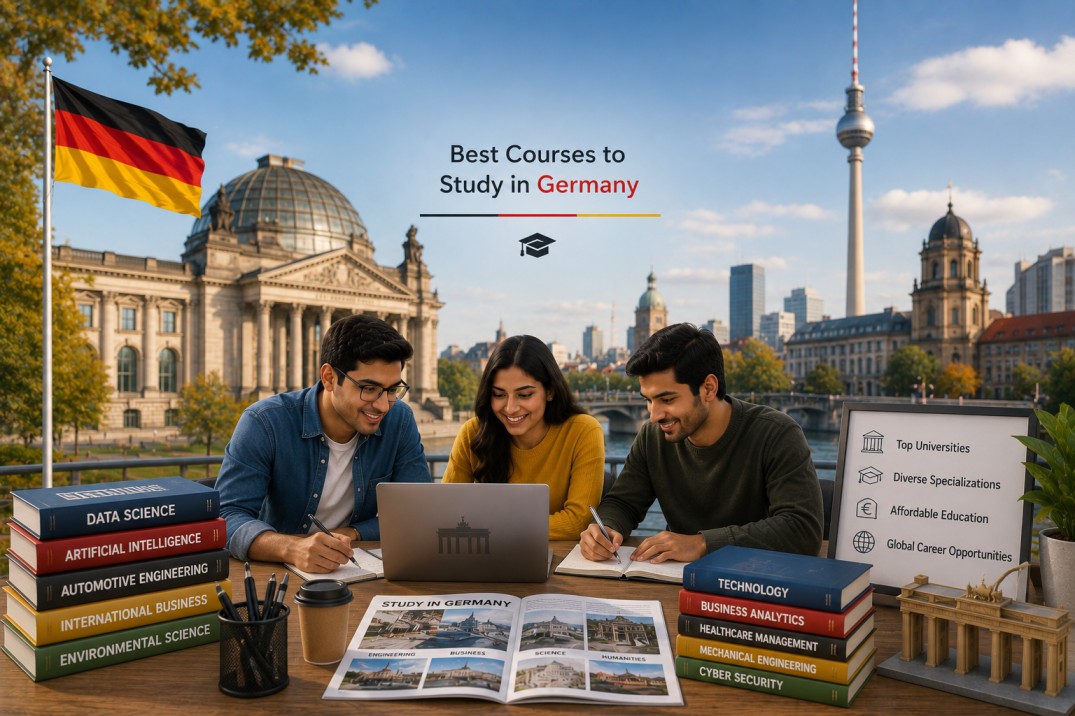
Germany has established itself as a global leader across several academic disciplines due to its innovation-driven economy and advanced industrial ecosystem.
The table below highlights the most popular study options.
Course | Why Germany? | Career Opportunities |
Mechanical Engineering | Global manufacturing leader | Automotive, Robotics |
Computer Science | Strong technology ecosystem | Software, AI, Cloud Computing |
Artificial Intelligence | Research-focused education | Machine Learning, AI Engineering |
Data Science | Growing digital economy | Business Intelligence, Analytics |
Automotive Engineering | Home to leading automobile companies | R&D, Design Engineering |
Business & Management | Strong international business environment | Consulting, Finance |
Renewable Energy | Sustainability leader | Green Energy, Environmental Engineering |
Biotechnology | Advanced healthcare research | Pharmaceuticals, Medical Research |
Learning German is highly recommended, as it greatly improves internship opportunities, networking, and long-term employability after graduation.
Best Student Cities in Germany
The city you choose can significantly influence your academic experience, networking opportunities, internship availability, and overall living costs.
The table below highlights Germany's most popular student cities.
City | Top Universities | Popular Industries |
Munich | TUM, LMU Munich | Automotive, Technology, Finance |
Berlin | TU Berlin, Humboldt University | Startups, AI, FinTech |
Aachen | RWTH Aachen University | Engineering, Manufacturing |
Stuttgart | University of Stuttgart | Automotive, Mechanical Engineering |
Dresden | TU Dresden | Electronics, Research |
University of Hamburg | Logistics, Maritime, Business |
Munich offers the strongest corporate ecosystem, Berlin leads in startups and innovation, while Aachen remains one of Europe's premier destinations for engineering education.
Living Costs in Germany
Although tuition fees are extremely low, students should still plan for accommodation, food, transportation, insurance, and personal expenses.
The blocked account requirement currently estimates average living expenses at approx. €992 per month ( approx. ₹1,10,000), although actual costs vary by city.
The table below provides a general cost of studying in Germany :
Expense | Approx. Annual Cost |
Accommodation | €4,500–7,500 (₹4.5–₹7.5 lakh) |
Food & Groceries | €2,400–3,000 (₹2.4–₹3 lakh) |
Health Insurance | €1,200–1,500 (₹1.2–₹1.5 lakh) |
Transportation | Usually Covered Through Semester Fee |
Miscellaneous | €1,500–2,500 (₹1.5–₹2.5 lakh) |
Overall living expenses typically range between €11,000 and €13,000 annually (₹11–₹13 lakh).
Scholarships for Indian Students in Germany
Germany is already one of the most affordable study destinations, several scholarships can further reduce your financial burden. Most scholarships are merit-based and may cover tuition (where applicable), monthly living expenses, research grants, or travel costs.
The table below highlights the most popular scholarships for Indian students in Germany.
Scholarship | Coverage | Eligibility |
DAAD Scholarships | Monthly stipend, travel, insurance | Primarily Master's & PhD students |
Deutschlandstipendium | €300/month (₹30,000/month approx.) | Academic excellence |
Erasmus+ | Tuition and mobility funding | Exchange and joint degree students |
Konrad-Adenauer Foundation | Monthly funding | Outstanding academic and leadership profile |
Heinrich Böll Foundation | Living allowance | Socially engaged students |
University-specific Scholarships | Partial tuition/living support | Varies by university |
Among these, DAAD (German Academic Exchange Service) remains the most prestigious funding opportunity for Indian students pursuing higher education in Germany.
Part-Time Work Opportunities in Germany
Germany allows international students to gain valuable work experience while studying. Part-time employment not only helps students manage their living expenses but also provides exposure to the German work culture and professional environment.
Students are generally permitted to work:
120 full working days per year, or
240 half working days per year
The current minimum wage is approximately €13.90 per hour (₹1,390/hour approx.), allowing many students to cover a significant portion of their monthly expenses.
Common student jobs include:
Research Assistant
Teaching Assistant
IT Support
Retail Associate
Hospitality Staff
Customer Service Executive
Warehouse Associate
Campus Ambassador
Students with German language proficiency have access to a wider range of part-time opportunities.
Career Opportunities After Studying in Germany
Germany's economy is driven by advanced manufacturing, engineering, information technology, healthcare, finance, and renewable energy. As Europe's largest economy, it offers excellent employment opportunities for international graduates, particularly in STEM fields.
The table below highlights some of the most popular career opportunities.
Job Role | Average Annual Salary | Major Recruiters |
Software Engineer | €55,000–75,000 (₹55–75 lakh) | SAP, Siemens, Amazon, Microsoft |
Data Scientist | €60,000–80,000 (₹60–80 lakh) | Bosch, BMW, SAP |
Mechanical Engineer | €55,000–75,000 (₹55–75 lakh) | Mercedes-Benz, Volkswagen, Porsche |
Automotive Engineer | €60,000–85,000 (₹60–85 lakh) | BMW, Audi, Daimler |
Business Analyst | €50,000–70,000 (₹50–70 lakh) | Deloitte, Accenture, PwC |
AI Engineer | €65,000–90,000 (₹65–90 lakh) | Siemens, SAP, Bosch |
Germany's shortage of skilled professionals continues to create strong demand across engineering, technology, manufacturing, healthcare, and business sectors.
Eligibility Requirements to Study in Germany
Admission requirements vary depending on the university and program. However, Indian students generally need the following.
The table below summarises the common eligibility criteria.
Requirement | Typical Requirement | Notes |
Academic Qualification | Recognised Bachelor's or Class 12 qualification | Depends on course level |
APS Certificate | Mandatory | Required before visa application |
English Proficiency | IELTS/TOEFL/PTE | For English-taught programs |
German Language | Usually not mandatory for English programs | A2/B1 recommended for jobs |
SOP & LORs | Required by many universities | Particularly for Master's programs |
For undergraduate programs, students may also need to complete a Studienkolleg if their academic qualifications are not directly recognised.
Germany Intakes & Admission Timeline
Planning your application well in advance increases your chances of securing admission and scholarships.
The table below outlines Germany's primary intakes.
Intake | Application Timeline | Classes Begin |
Winter Intake (Primary) | October – May | September/October |
Summer Intake | September – January | March/April |
The Winter Intake offers the largest number of English-taught programs and scholarship opportunities, making it the preferred choice for most Indian students.
How to Apply to German Universities
The admission process is straightforward but requires careful planning.
Step 1: Shortlist universities and English-taught programs.
Step 2: Check admission requirements and deadlines.
Step 3: Obtain your APS Certificate.
Step 4: Prepare IELTS/TOEFL scores if required.
Step 5: Arrange academic transcripts, SOP, resume, and recommendation letters.
Step 6: Submit applications through Uni-Assist or directly through the university portal.
Step 7: Receive your admission offer.
Step 8: Open your blocked account.
Step 9: Apply for your German Student Visa.
APS Certificate
The Academic Evaluation Centre (APS) India verifies Indian academic documents before students apply for German universities and student visas.
Without an APS certificate, Indian students cannot proceed with their German student visa application.
Students should apply for APS several months before university deadlines because processing times may vary.
Blocked Account Requirement
One of the most important financial requirements for obtaining a German student visa is opening a Blocked Account (Sperrkonto).
The blocked account demonstrates that students have sufficient funds to support themselves during their first year in Germany.
Current requirement:
€11,904 (₹11.9 lakh approx.)
Monthly withdrawal limit: €992 (₹99,000 approx.)
Popular blocked account providers include Expatrio, Fintiba, and Coracle.
Student Visa Process for Germany
After receiving your admission letter, the next step is applying for a German National Student Visa.
The following documents are typically required:
University Admission Letter
APS Certificate
Passport
Blocked Account Confirmation
Health Insurance
Academic Documents
Visa Application Form
Passport-size Photographs
IELTS/TOEFL (if applicable)
Students should begin the visa process immediately after receiving admission due to appointment availability.
Challenges of Studying in Germany
While Germany offers outstanding educational opportunities, students should also be aware of a few practical challenges.
Learning basic German significantly improves employability and daily life.
Securing accommodation can be competitive in cities like Munich and Berlin.
The job market is strong but requires proactive networking and internship experience.
German bureaucracy may initially seem time-consuming for international students.
Winters can be colder than many Indian students expect.
Understanding these challenges beforehand helps students prepare for a smoother transition.
Author’s Final Thought
Germany has established itself as one of the best destinations for Indian students, with tuition-free public universities, world-class STEM programs, over 2,000 English-taught courses and an 18-month post-study work visa, Germany offers exceptional value compared to many other international study destinations. Some tips to keep in mind:
Apply for your APS Certificate before university applications begin.
Start learning basic German (A2–B1) to improve employability.
Begin your application process at least 10–12 months before your preferred intake.
Research accommodation options early, especially in Munich and Berlin.
Take advantage of internships and research opportunities during your studies. Attend career fairs and networking events from your first semester.
Keep your blocked account and visa documents ready well before your departure.
Also read about Popular courses in Germany:
Book a free 1:1 counselling session with our experts today, to start your study abroad journey.