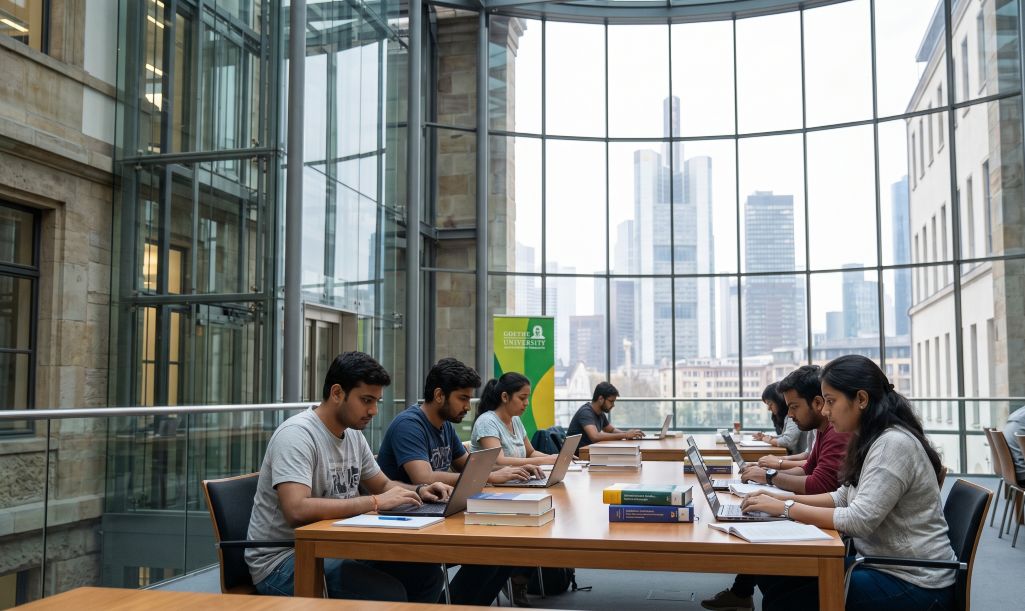
Study in Frankfurt in 2026
Table of Contents
- Why Study in Frankfurt is a Right Choice for Indian Students
- Education System in Frankfurt
- Top Universities to Study in Frankfurt for Indian Students in 2026
- Acceptance Rate in Frankfurt Universities for Indian Students in 2026
- Popular Courses to Study in Frankfurt for Indian Students in 2026
- Admission Requirements for Study in Frankfurt in 2026
- Cost of Studying in Frankfurt for Indian Students in 2026
- Cost of Living in Frankfurt for Indian Students in 2026
- Scholarships in Frankfurt for Indian Students in 2026
- PR and Settlement in Frankfurt for Indian Students in 2026
- Job Opportunities in Frankfurt for Indian Students in 2026
- Tips for Indian Students Planning to Study in Frankfurt
- Conclusion
Frankfurt offers Indian students a world-class European education, often featuring free tuition at top public universities like Goethe University Frankfurt. At these institutions, you only pay a nominal semester fee of around €350 (₹38,815), which conveniently covers local public transport. Beyond academia, Frankfurt provides unmatched proximity to the European Central Bank and major global corporate hubs, unlocking exceptional global career prospects. While living expenses are higher than the German average, this vibrant, international financial hub is ideal for Indian students pursuing highly prestigious programs in STEM, finance, and business management.
Why Study in Frankfurt is a Right Choice for Indian Students
Frankfurt combines rigorous academic excellence with direct access to the European Central Bank and a massive international financial ecosystem. Indian students pursuing business, finance, or data science can seamlessly transition from university into a high-paying, robust European job market.
The following table outlines the key highlights and recent updates for international students looking to study in Frankfurt in 2026.
Category | Details |
Top Universities | Goethe University Frankfurt, Frankfurt School of Finance & Management |
Top Courses | Finance, MBA, Data Science, Business Administration, Computer Science |
Work Rules | Full-time students can legally work up to 20 hours/week during terms and full-time during holidays. |
Settlement Pathway | Graduates secure an 18-month job-seeker visa, paving the way for the EU Blue Card and Permanent Residency. |
Source: DAAD (German Academic Exchange Service) & Federal Foreign Office
Education System in Frankfurt
The education system in Frankfurt features a powerful mix of prestigious public research universities and highly specialized applied science institutes. Aligning with global standards, these institutions provide internationally recognized degrees that equip students with both theoretical depth and corporate-ready practical skills.
Education Levels: Duration & Outcomes
Frankfurt's degree levels build robust theoretical knowledge before moving toward highly specialized corporate applications.
The following table breaks down the duration and structure of different study levels in Frankfurt, as noted in Study in Germany Doc.docx.
Level | Duration | Details |
Bachelor’s | 3–4 years | Strong theoretical focus at research universities; practical applications at applied science institutes. |
Master’s | 1–2 years | Coursework-based or research-based options; massive availability of English-taught programs. |
Doctorate (PhD) | 3–5 years | Highly advanced research, often fully funded through university stipends or industry grants. |
Source: Federal Ministry of Education and Research (BMBF)
Credit & Grading System
Frankfurt institutions utilize the European Credit Transfer and Accumulation System (ECTS) and a 1.0 to 5.0 grading scale. The following table illustrates the standard grading methodology across major Frankfurt universities.
Aspect | Details |
Grading Scale | 1.0–1.5 (Very Good), 1.6–2.5 (Good), 2.6–3.5 (Satisfactory), 3.6–4.0 (Sufficient), 5.0 (Fail) |
Academic Load | Typically 30 ECTS credits per semester. |
Pass Requirement | A minimum grade of 4.0 is strictly required to pass a module. |
Source: German Rectors' Conference (HRK)
Types of Institutions: Key Features & Examples
Students can select from autonomous public research universities, applied science universities, and private educational institutes. The following table categorizes the primary types of higher education institutions in Frankfurt.
Type | Key Features | Examples (QS Global Rank 2026) |
Universitäten (Research) | Government-backed, highest global prestige, intense research funding, PhD granting. | Goethe University Frankfurt (#316) |
Fachhochschulen (Applied) | Focus on practical skills, mandatory industry internships, highly valued by corporate recruiters. | Frankfurt University of Applied Sciences (Unranked) |
Private Institutes | Charge tuition fees, flexible admission, heavily focused on English-taught business degrees. | Frankfurt School of Finance & Management (Unranked / #40 QS Global MBA) |
Source: DAAD Higher Education Compass
Top Universities to Study in Frankfurt for Indian Students in 2026
Frankfurt is home to renowned institutions specializing in finance, management, and applied sciences. These universities maintain exceptionally strong industry ties with global corporations, providing outstanding post-graduation career support for ambitious Indian students.
Universities for Engineering & Technology in Frankfurt
Frankfurt offers solid applied engineering programs focusing heavily on practical and industry-ready skills.
The following table lists top engineering and tech-focused institutions in Frankfurt alongside their QS global standings and fees.
University | Global Rank (2026) | Annual Tuition (EUR) / (INR) |
Frankfurt University of Applied Sciences | #100 + (THE Ranking) | €0 (Only semester fee ~€350 / ₹38,815) |
Goethe University Frankfurt | #316 (QS Rankings) | €0 (Only semester fee ~€350 / ₹38,815) |
Source: QS World University Rankings 2026
Universities for Management / MBA in Frankfurt
Business schools in Frankfurt are celebrated globally for dynamic programs deeply integrated with European financial markets.
The following table outlines prominent universities for business and management studies in Frankfurt.
University | QS Global Rank (2026) | Annual Tuition (EUR) / (INR) |
Frankfurt School of Finance & Management | #40 (Global MBA) | €40,000 / ₹4,436,000 |
Goethe University Frankfurt | #316 | €0 (Only semester fee ~€350 / ₹38,815) |
Source: QS World University Rankings 2026
Universities for MS (Computer Science / Data Science) in Frankfurt
Frankfurt provides top-tier education for future data scientists and software engineers aiming for the corporate sector.
The following table showcases leading IT and computer science institutions in Frankfurt.
University | QS Global Rank (2026) | Annual Tuition (EUR) / (INR) |
Goethe University Frankfurt | #316 | €0 (Only semester fee €350 / ₹38,815) |
Frankfurt University of Applied Sciences | It is not currently featured in the main global QS World University Rankings | €0 (Only semester fee €350 / ₹38,815) |
Source: QS World University Rankings 2026
Universities for Medicine & Life Sciences in Frankfurt
Medical and life science education in Frankfurt focuses on advanced clinical training and biomedical research.
The following table presents top-tier medical and life science faculties in Frankfurt.
University | QS Global Rank (2026) | Annual Tuition (EUR) / (INR) |
Goethe University Frankfurt | #316 | €0 (Only semester fee €350 / ₹38,815) |
Source: QS World University Rankings 2026
Acceptance Rate in Frankfurt Universities for Indian Students in 2026
Admission to Frankfurt's public universities relies heavily on strictly meeting criteria like the Numerus Clausus (NC) cutoff. Conversely, private institutions like the Frankfurt School of Finance offer more welcoming admission quotas tailored for international business students.
The following table details approximate acceptance rates across different university tiers in Frankfurt.
Tier | Rate Range | Examples |
NC Restricted (Highly Selective) | 5–15% | Goethe University Frankfurt |
Non-NC Public Programs | 40–60% | Frankfurt University of Applied Sciences |
Private Education Institutes | 60–80% | Frankfurt School of Finance & Management |
Source: International Student Admissions Data Germany
Popular Courses to Study in Frankfurt for Indian Students in 2026
Given Frankfurt's unparalleled status as a financial hub, Indian students heavily favor Finance, Business Administration, and Data Science. These programs offer an incredible return on investment and high employability in the surrounding corporate landscape.
The following table highlights the most popular programs in Frankfurt and their approximate financial commitments.
Course | University Examples | Average Annual Tuition (EUR) / (INR) |
MS Data Science / AI | Goethe University Frankfurt | €0 / ₹0 |
MBA / Management | Frankfurt School of Finance & Management | €40,000 / ₹4,436,000 |
Applied Engineering | Frankfurt University of Applied Sciences | €0 / ₹0 |
Finance / Economics | Goethe University Frankfurt | €0 / ₹0 |
Source: International Student Enrollment Statistics, Germany
Admission Requirements for Study in Frankfurt in 2026
Securing admission in Frankfurt demands a pristine academic background, a verified APS certificate, and proven language proficiency. The application process is generally streamlined through direct university portals or centralized systems like uni-assist.
Eligibility by Degree Level
Academic prerequisites in Frankfurt scale strictly according to the complexity of the desired degree program. The following table outlines standard eligibility criteria for different study levels.
Level | Academic Requirement | Key Notes |
Bachelor’s | 13 years of education or clearing JEE Advanced. | Indian 12-year schooling requires a mandatory 1-year Studienkolleg course. |
Master’s | Strong Bachelor's degree (3 or 4 years). | Strict requirement for matching ECTS credits to the master's subject. |
Doctorate (PhD) | Excellent Master's record. | Must secure a faculty supervisor prior to applying. |
Required Documents
International applicants must compile a comprehensive dossier of verified academic, personal, and financial documents.
The following table lists the essential paperwork needed for Frankfurt applications.
Category | Items Needed |
Academic | APS Certificate, translated transcripts, degree certificates. |
Personal & Professional | Valid passport, Statement of Purpose (SOP), LORs, Europass Resume/CV. |
Financial | Blocked Account confirmation (€11,900 / ₹1,319,710), Proof of Health Insurance. |
Source: DAAD
Standardized Tests for Indian Students in 2026
Standardized testing is frequently required for competitive programs in Frankfurt to prove academic readiness.
The following table clarifies common standardized testing requirements for Frankfurt institutions.
Exam | Level | Notes |
GRE / GATE | PG (Master's) | Highly recommended for competitive master's programs. |
GMAT | PG (MBA) | Mandatory for top MBA programs at private business schools. |
Language Proficiency for Indian Students in 2026
Depending on the medium of instruction, Indian students must prove high English or German language proficiency. The following table details the language requirements for university courses in Frankfurt.
Test | Competitive Scores (2026) |
IELTS Academic | 6.5–7.0 overall (For English-taught programs) |
TestDaF / DSH | TDN 4 / DSH-2 (For German-taught programs) |
Student Visa Process for Indian Students in 2026
Indian students must obtain a National Visa (Type D) from the German Embassy to study in Frankfurt. The following table breaks down the steps to secure a Student Visa.
Step | Requirement | Details |
1 | APS Certificate | Verify Indian academic documents through the Academic Evaluation Centre. |
2 | Blocked Account | Deposit €11,900 (₹1,319,710) to prove funds for living costs. |
3 | Health Insurance | Secure mandatory statutory or private health insurance coverage. |
4 | VFS Appointment | Submit biometrics, admission letter, and original documents at VFS Global. |
5 | Residence Permit | Convert the entry visa to a residence permit at the local Ausländerbehörde upon arrival. |
Cost of Studying in Frankfurt for Indian Students in 2026
Studying in Frankfurt requires a well-planned budget for living expenses, but tuition at public universities remains practically zero. Private institutions command higher fees but offer specialized corporate networking opportunities within the city's financial sector.
Tuition Fees (Semester Wise) for Indian Students in 2026
Public universities in Frankfurt bill a nominal administrative fee per semester instead of hefty tuition charges.
The following table shows approximate semester-wise splits for full-time programs.
Institution Type | Per Semester (EUR) / INR | Annual (EUR) / INR |
Public Universities | €350 / ₹38,815 | €700 / ₹77,630 |
Private Institutes | €5,000–€10,000 / ₹554,500–₹1,109,000 | €10,000–€20,000 / ₹1,109,000–₹2,218,000 |
Tuition Fees (Course Wise) for Indian Students in 2026
Private business and MBA degrees incur the highest fees, while public university degrees remain incredibly affordable.
The following table compares average annual fees by academic discipline in Frankfurt.
Course | Annual Tuition (EUR) | Annual Tuition (INR) |
Engineering / Technology | €300–€3,000 | ₹33,270–₹332,700 |
Computer Science / IT | €300–€3,000 | ₹33,270–₹332,700 |
MBA / Management (Private) | €15,000–€40,000 | ₹1,663,500–₹4,436,000 |
Cost of Living in Frankfurt for Indian Students in 2026
Frankfurt is a major financial hub, making its living costs slightly higher than the German average. However, by leveraging shared student housing (WG) and the semester ticket for public transit, Indian students can successfully manage their budget within their blocked account limits.
The following table breaks down typical monthly expenses for a student in Frankfurt.
Expense | Monthly Cost (EUR) | Monthly Cost (INR) |
Housing (Student Dorm / WG) | €350–€600 | ₹38,815–₹66,540 |
Food & Groceries | €200–€250 | ₹22,180–₹27,725 |
Health Insurance | €120 | ₹13,308 |
Transportation | €0 (Covered in Semester Fee) | ₹0 |
Utilities & Internet | €50–€80 | ₹5,545–₹8,872 |
Leisure & Miscellaneous | €100–€150 | ₹11,090–₹16,635 |
Source: Deutsches Studentenwerk Surveys 2026
Most Preferred Cities for Indian Students in Frankfurt
Indian students typically choose neighborhoods that balance affordability with campus proximity and transport links.
Bockenheim: Close to Goethe University's historical campus, offering a lively and highly affordable student atmosphere.
Nordend: A popular, vibrant district with numerous cafes and excellent connectivity to major university campuses.
Sachsenhausen: Known for its cultural scene and river views, popular among older students and working professionals.
Scholarships in Frankfurt for Indian Students in 2026
Although public tuition is largely free, scholarships provide crucial financial support to cover Frankfurt's living costs. High-achieving Indian students can apply for government and political foundation stipends to significantly ease their financial burden.
The following table lists top scholarships available for students in Frankfurt.
Name | Main Eligibility | Scholarship Amount & Details |
DAAD Scholarships | High academic merit, strong SOP | €934/month (₹103,580), covering full living costs. |
Deutschlandstipendium | Excellent grades and social engagement | €300/month (₹33,270) funded by university and sponsors. |
Friedrich Ebert Stiftung | Strong academic record, political involvement | Up to €934/month (₹103,580) plus health insurance. |
Heinrich Böll Foundation | Outstanding academics, strong interest in political ecology | Covers standard monthly living costs of €934/month (₹103,580). |
Konrad-Adenauer-Stiftung (KAS) | Excellent academic performance, active voluntary work | €934/month (₹103,580) for master's students alongside networking allowances. |
Source: DAAD Scholarship Portals
How to Apply to Scholarships for Indian Students
Scholarship applications require a pristine academic profile and early preparation independent of university admission. The following table outlines the general scholarship application roadmap.
Step | Action | Timeline |
1. Research | Check foundation portals for strict deadlines and criteria. | 10–12 months before intake |
2. Prepare Documents | Gather strong LORs, motivation letter, and proof of engagement. | Aug–Oct (for Winter intake) |
3. Submit Application | Apply directly through the scholarship portal. | Oct–Dec |
4. Interview | Participate in a personal or online interview. | Feb–April |
Source: DAAD & Foundation Scholarship Portals
PR and Settlement in Frankfurt for Indian Students in 2026
Frankfurt offers a highly structured and incredibly fast pathway for Indian graduates to secure Permanent Residency (PR). By entering the thriving local tech or finance sectors, graduates can easily integrate economically and fulfill immigration requirements.
Pathway from Student to PR
Transitioning to permanent residency requires systematic planning and consistent contributions to the local economy after graduation.
Graduate Successfully: Complete a degree at an accredited Frankfurt university to unlock post-study work privileges.
Job-Seeker Visa: Utilize the 18-month post-study visa to reside in Frankfurt and secure a qualified professional role.
Secure the EU Blue Card: Land a professional position meeting standard salary or shortage-field thresholds.
Pay Pension Contributions: Accumulate monthly statutory pension contributions while maintaining lawful employment.
Fast-Track Settlement: Apply for permanent settlement in 21 months with B1 German, or 33 months with A1 German.
Job Opportunities in Frankfurt for Indian Students in 2026
Frankfurt’s robust financial ecosystem and growing tech sector offer phenomenal career prospects for international graduates. With an incredibly strong corporate ecosystem and a severe shortage of skilled tech and finance workers, Indian students benefit from direct pathways into a high-paying European job market.
The following table highlights high-demand roles for Indian graduates in Frankfurt and their earning potential.
Job Role / Title | Average Annual Salary (EUR) | Average Annual Salary (INR) |
Financial / Business Analyst | €60,000–€100,000 | ₹6,654,000–₹11,090,000 |
Data Scientist | €60,000–€90,000 | ₹6,654,000–₹9,981,000 |
Software Engineer / AI Developer | €55,000–€85,000 | ₹6,099,500–₹9,426,500 |
Mechanical / Automotive Engineer | €50,000–€75,000 | ₹5,545,000–₹8,317,500 |
Supply Chain Manager | €45,000–€70,000 | ₹4,990,500–₹7,763,000 |
Digital Marketing / SEO Manager | €45,000–€65,000 | ₹4,990,500–₹7,208,500 |
In-Demand Domains in Frankfurt:
Frankfurt's current job market heavily prioritizes professionals in finance, technology, and consulting to drive corporate innovation.
Finance, Fintech & Venture Capital: As the financial heart of the Eurozone, Frankfurt demands corporate financial analysts, valuation modeling experts, and VC professionals.
IT, Data Science & AI: There is a critical vacuum for software developers, AI modelers, and cybersecurity experts within banking tech hubs.
Business & Strategy Consulting: High demand exists for strategy consultants navigating digital transformation across global corporate headquarters.
Green Technology & Renewable Energy: Accelerating climate initiatives have significantly driven recruitment for sustainability specialists and smart grid engineers.
Supply Chain & Logistics: Given Frankfurt's status as a massive European transit and airport hub, agile logistics managers are heavily sought after.
Digital Marketing & Growth SEO: Booming local enterprises and agencies aggressively recruit experts in technical SEO, conversion optimization, and data-driven marketing.
Top Job Roles and Salary in Frankfurt
Graduates in Frankfurt can expect highly competitive starting salaries and rapid corporate career progression. The following table highlights top entry-level roles in Frankfurt and their expected monthly earning potential.
Job Role / Title | Average Monthly Salary (EUR) | Average Monthly Salary (INR) |
Financial / Business Analyst | €3,500–€4,500 | ₹388,150–₹499,050 |
Junior Software Developer | €4,000–€5,000 | ₹443,600–₹554,500 |
Data Analyst | €4,200–€5,500 | ₹465,780–₹609,950 |
Junior Mechanical Engineer | €3,800–€4,800 | ₹421,420–₹532,320 |
Junior Supply Chain Analyst | €3,200–€4,200 | ₹354,880–₹465,780 |
Digital Marketing Executive | €3,000–€4,000 | ₹332,700–₹443,600 |
Tips for Indian Students Planning to Study in Frankfurt
Adapting to Frankfurt's fast-paced environment requires strategic preparation and cultural integration. These tips will help Indian students successfully navigate and maximize their academic and professional journey.
Learn German Actively: Even in a highly international city like Frankfurt, conversational German is vital for networking and securing local jobs.
Embrace WG (Shared Housing): Renting a room in a Wohngemeinschaft is crucial to afford Frankfurt's higher living costs comfortably.
Seek 'Werkstudent' Roles: Target working student positions in Frankfurt's banking or tech sectors for lucrative corporate experience.
Strict Adherence to Deadlines: German bureaucracy is incredibly rigid; missing a visa or university document deadline can result in rejection.
Conclusion
Studying in Frankfurt in 2026 is an exceptionally strategic move for ambitious Indian students seeking global career advancement. By eliminating tuition fees, public institutions like Goethe University allow students to focus their budgets entirely on living costs via the €11,900 (₹1,319,710) blocked account. Frankfurt’s position as Europe’s financial epicenter provides direct avenues into high-growth sectors like corporate finance, AI, technical SEO, and supply chain management. By proactively learning the German language, securing relevant Werkstudent roles, and leveraging the 18-month post-study visa, Indian graduates can confidently secure high-paying positions. This robust ecosystem ensures a phenomenal return on investment and a rapid, structured path to permanent residency in the heart of Europe.
Ready to kickstart your academic journey in Frankfurt? Book a free consultation with our study abroad experts today!